Thursday, January 26, 2012

Day 179.5 Chinese New Year Green Tea Fortune Cookies


This recipe for Green Tea Fortune Cookies was sent to me by my awesome friend, fellow Cantabrigian and foodie, Becky V. Featured in the Huffington Post, this recipe came complete with commentary from Joanne Chang, who just so happens to be my baking goddess-idol, so how could I go wrong?  Actually, things could have gone very wrong because the recipe calls for matcha green-tea powder, which I didn't have and had no time to get. But, seeing as necessity is indeed the mother of invention, I took some Chinese green tea I had in my pantry, got out my handy-dandy mortar and pestle and ground it to a to a semi-fine powder, (leaving some flakes for texture). Presto - sort of matcha green tea powder. I can't say for sure that my pedestrian stand-in rivaled the finely milled Japanese tea (because I haven't had it), and it's definitely not the lovely green hue of matcha, but all things considered, the recipe was both flavorful and fun to make and that seems like the perfect combination to honor the Chinese New Year. Enjoy!

Celebrated from January 22-28, 2012 is the Year of the Water Dragon. Now referred to as the Spring Festival, the Chinese New Year dates back to the 20th century and is the most important holiday celebration in China. At one time, the celebration was tied to the lunar-solar Chinese calendar during which time heavenly deities and ancestors were celebrated. In 1912, the Chinese adopted the western calendar and began observing January 1st as the New Year but kept the traditional customs of the Chinese New Year/Spring Festival as time to renew family ties. Of course food plays an important roll in the celebration. Fortune cookies were first introduced in San Francisco in the late 1800, and many other foods represent wishes for health and prosperity. For example, spring rolls are equated with wealth, fish signifies abundance, tangerines and oranges signify luck and wealth and sticky rice cakes offer up wishes for a sweet, rich life. I just love that.

Make up your very own fortunes or use some of your favorites
 I didn't have Japanese Macha Green Tea, so I improvised with a few bags of Chinese tea
 The basics: egg whites, sugar, flour, melted butter and green tea
 Pour in the egg whites
 Add the flour
 Whisk until smooth, then refrigerate for an hour
 Spread in 4-inch rounds using an off-set spatula or the back of a spoon
 Invert the cookie, put the fortune on, fold the edges together and crease over a coffee mug
 Place in muffin tins to hold the shape while they cool
Happy New Year!

** A note about these cookies. The original recipe called for 2 tbsp. of batter, spread to 6-inch rounds. I found these to be too big and too thick, so I've adapted the amount to create a smaller thinner cookie. Also, be sure to let the edges of the cookie bake up to a fairly golden color, otherwise they'll be too chewy and the fortunes will stick to the dough.


Green Tea Fortune Cookies (Recipe adapted from Joanne Chang, Huffington Post)
Ingredients


3/4 cup sugar
3 large egg whites
4 ounces unsalted butter, melted and cooled
1/2 cup all-purpose flour
1 tablespoon matcha green-tea powder or 3/4 Tbsp ground Chinese green tea
18 small paper fortunes

Directions
  1. In a medium bowl, whisk the sugar with the egg whites, butter, flour and green-tea powder until smooth. Cover the batter and refrigerate for 1 hour.
  2. Preheat the oven to 325° and line a baking sheet with a silicone mat. Have a coffee mug and standard-size muffin tin handy. Spoon two 1-tablespoon-size mounds of batter onto the baking sheet, 6 inches apart. Using an offset spatula, spread the batter to make two 4-inch rounds.
  3. Bake in the center of the oven for 12 to 14 minutes, until the edges are browned and the centers are still light. Let cool for 10 seconds, then using a spatula, invert one tuile and place a paper fortune in the center. Fold the tuile in half and then bring the ends together, using the rim of the coffee mug to make the crease. Set the fortune cookie in a muffin cup to hold its shape. Repeat with the second tuile. If the tuile hardens, return it to the oven for a few seconds. Repeat with the remaining batter and fortunes. Let the cookies cool completely before serving.


© 2010-2011, What's Cooking in Your World? Sarah Commerford/All Rights Reserved

Thursday, January 19, 2012

Day 179! Trinidad and Tobago ~ Doubles ~ Barra with Channa and Cucumber Chutney - Up Next, Tunisia


This incredible "Doubles" recipe from Trinidad and Tobago made it to my top 5 favorite meals of all the dishes I've cooked so far since I started this project in April 2010. Partly because it's unique, delicious and captures the smells and flavors of this beautiful West Indian country, but also, because of the generosity of friends who helped make it possible. Props to:  Gary Ottley, photographer extraordinaire (check out his site if you want to be inspired) for taking time out of his busy schedule to share favorite dishes from his country of origin; to Eric Ackerson, whose My Hungry Tum professional, international food blog (started way before mine and should be a book) for sharing his tamarind hot sauce recipe; to Ben, my husband's best friend my foodie soul-mate, for snagging a bag of tamarind, delivering it to my house and showing me how to peel (and eat) it; to my Facebook friends who passed on leads to various stores and food sources; and, last but never least, to my awesome husband and sons for always supporting my on-going journey. It's a diverse and spicy world we live in, and all of you make it that much sweeter - much love.

An archipelagic state in the southern Caribbean, Trinidad and Tobago (2 islands) is on the coast of northeastern Venezuela and south of Grenada in the Lesser Antilles. The country shares maritime borders with Barbados, Guyana and Venezuela. In 1498 Columbus landed on and named Trinidad. A century later, the Spaniards settled the island, and wiped out the the indigenous Arawak and Carib Indians, keeping rule of the Island until the British captured it in 1797. During Colonial rule, sugar and cocoa plantations were the primary source of revenue. Subsequently, however, the island changed hands 22 times, more than any other West Indian islands. In 1803, Britain took Tobago and by 1888, both Trinidad and Tobago were incorporated into a single colony. The country finally gained independence in 1962 and became a republic in 1876. The majority of the population are of African and East Indian descent, with others including  Hindi, French, Patois, Creole and East Indian.

Cuisine in Trinidad and Tobago has it's roots in Spanish, French, British, Amerindian, African, Indian, Chinese, Middle Eastern and Portuguese traditions. Therefore, traditional African stews, one-pot dishes, pelau, macaroni pie, plantain, callaloo and chicken and red beans are all part of the interesting and rich cuisine enjoyed on the islands. Creole traditions include oxtail soup, beef soup and cowheel soup. Curries and fish dishes of all kinds are popular, including two of my favorites, curried goat and duck. Loved by all (even here in the U.S.) is roti and the unofficial national breakfast, "Doubles", so named because 2 pieces of barra (bread) are always served with the chickpea filling and chutney. Still other foods that can be found include: bake and shark, pepper sauce, fruit chows, souse, chip-chip, conch and wild meat. Lastly, all kinds of tropical fruits such as coconut, mango, pineapple and papaya (to name but a few), round out this country's wonderful offerings.

Doubles Barra Dough 


This dough is meant to be sticky, so don't panic! Let rise until doubled in bulk

Barra rolled into 32 balls - let rise another 10-15 minutes

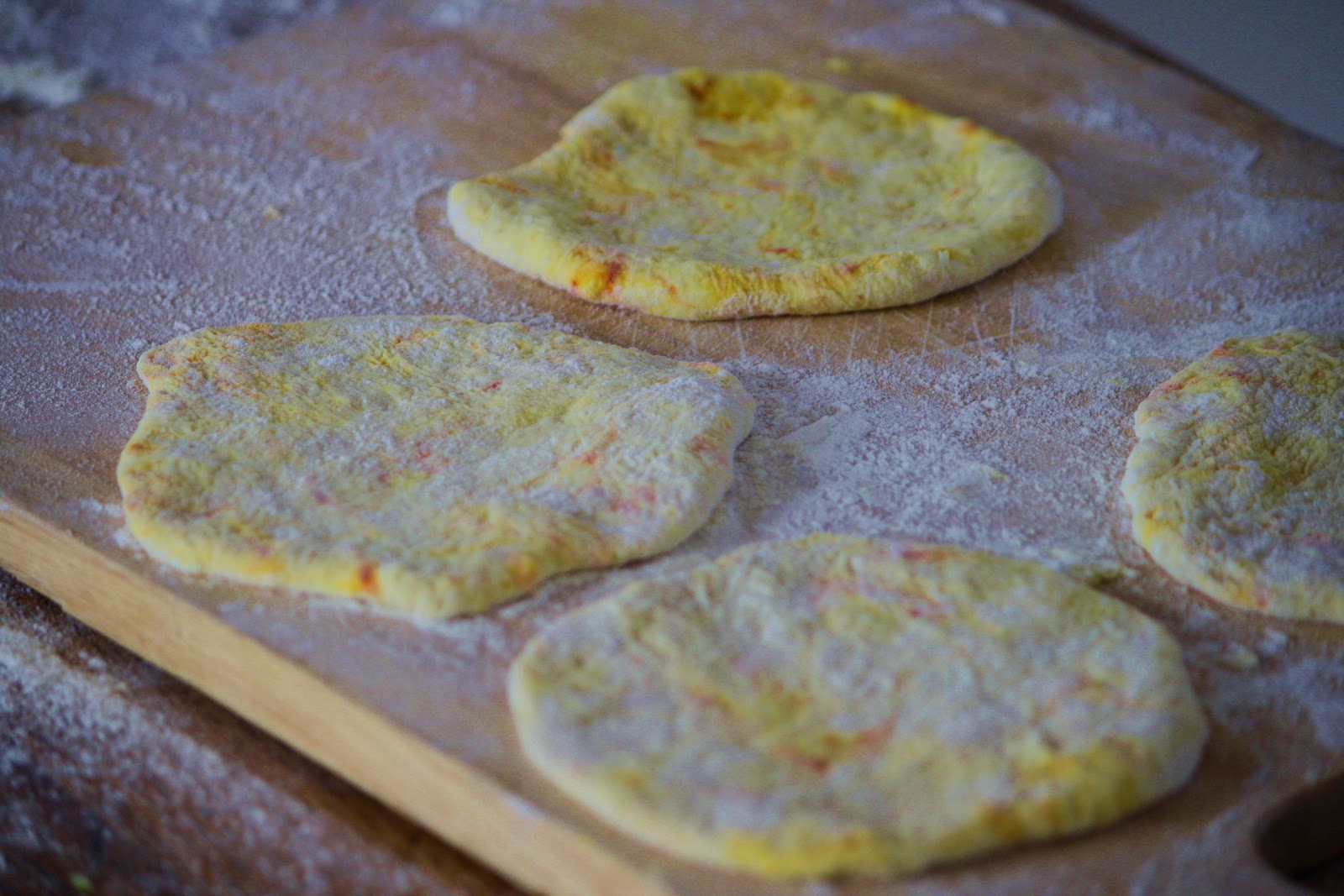
Roll out - this was a little tricky because the dough was so sticky and quite elastic

Fried up to golden perfection - this is one of those things that you get better at with practice

Channa, chickpea filling - I used canned chickpeas because I ran out of time :)

Cooked down until nice and soft, but not too mushy

Cucumber Chutney - I used Persian cucumbers which are seedless and don't require peeling 

Julienned and grated cucumbers

Tamarind for Eric's Hot Sauce - these are tricky and sticky to work with, but delicious

I used mango orange juice because that's what I had, but plain OJ or grapefruit works well too

Tamarind Seeds

Layer the chutney on chickpeas, then top with hot sauce ....... West Indian awesomeness


Barra (recipe courtesy of Amazing-Trinidad-Vacations.com) - Step 1
This recipe makes approximately 36 barra (18 doubles)
 4 cups - all purpose flour
 2 teaspoons - saffron powder
 1 teaspoon - ground geera (cumin, preferable roasted)
 3 teaspoons - yeast
 ½ teaspoon - sugar
 1 teaspoon - salt (adjust to taste)
 Cranola oil for frying
  1. Put 1 cup of lukewarm water in a small bowl, add sugar and sprinkle with yeast. Then leave mixture until it swells to twice its size.
  2. Combine flour, salt, saffron and geera in a large bowl.
  3. Add yeast to flour mixture along with 1¼ cups of water and mix into slightly firm dough. Mix well but try to handle dough as little as possible, cover and let it rise to double its size, then form dough into 36 small balls and then let rise for another 10 to 15 minutes.
  4. Take a ball of the barra dough and pat into a flattened 4-inch circle with both hands. If the dough sticks to your hands dampen hands with water. Fry immediately after shaping in hot oil, turning once. Drain on paper towels and allow to cool to room temperature.
Channa - Step 2
1 (16oz) can - channa (chick peas or garbanzo beans)
1 teaspoon - ground coriander
1 tablespoon - ground geera (cumin, preferably roasted)
2 tablespoons - cranola oil
1 small - onion
4 cloves - garlic
2 tablespoons - chive
½ teaspoon - turmeric powder ½ teaspoon each - salt and black pepper (adjust to taste)
  1. Dice onion, garlic and chive, keeping each separate.
  2. Put oil in a pot along with finely chopped onion and saute on medium heat until onion begins to caramelize.
  3. Add all remaining ingredients and mix thoroughly.
  4. Add enough water to cover channa by about 1½ inches, and then boil channa until it's very soft. Depending on the type of pot you use, and how often you remove the lid to stir, you may need to add water during this process. When you are finished cooking there must be some liquid left in pot, don't let it dry out.
Cucumber Chutney - Step 3
There are a variety of sauces and chutneys that can be used to spice up the basic Trinidad Doubles recipe, the most common of these are made from shadow benne, hot pepper, mango, tamarind, cucumber, and coconut. Try this Cucumber Chutney to add an extra dimension to your doubles...

1 large - cucumber
1 tablespoon - shadow beni (cilantro)
1 tablespoon - chives
1 - scotch-bonnet pepper (habanero pepper)
4 cloves - garlic
2 teaspoon - fresh Caribbean lime juice
½ teaspoon each - salt and black pepper (adjust to taste)
¼ teaspoon - brown sugar
  1. Julienne ¾ of cucumber into relatively small pieces. Cucumber seed and skin can be removed if you choose. We leave about a ¼ of skin to add color to chutney. Grate remainder of cucumber and add to mixture, which adds moisture to chutney.
  2. Finely dice garlic, cilantro and chives and add to mix.
  3. Finely dice pepper without touching it if possible, you don't want to inadvertently get this pepper in, or near, your eye.
  4. Gradually add the diced pepper to mix until it is spicy enough for your taste. Optionally, you may leave out some, or all, of the pepper, and use a tasty Caribbean pepper sauce to add the level of spice you desire when preparing individual Doubles.
Tamarind Hot Sauce (Recipe Courtesey of Eric Ackerson) - Step 4
1 peeled carrot
2-3 hot peppers (not deseeded)
1 tablespoon of vinegar
a pinch of salt
1/4 cup orange or grapefruit juice
5 whole tamarind pods peeled and deseeded or about 1/8 cup of tamarind pulp

Whirl that food processor till everything has reached a nice consistency and then allow 1/2 hour for the flavors to meld.

Trinidad Doubles -  Final Step 
With all the elements prepared, it is now time for the last step in the assembly of your Trinidad Doubles recipe. On a plate, place 2 barra side-by-side but overlapping slightly. Now, add a tablespoonful of channa and a liberal garnish of cucumber chutney, then finally, a drizzle of Trinidad pepper sauce to create the level of spiciness you desire. Enjoy.


© 2010-2011, What's Cooking in Your World? Sarah Commerford/All Rights Reserved

Thursday, January 12, 2012

Day 178! Togo ~ Peanut Chicken with Black Eyed Peas and Spinach - Up Next, Trinidad and Tobago


In my humble opinion, there's never a bad time to throw down a heaping plate of hearty peanut stew, black eyed peas and spinach...which is exactly what I'm doing as I write this Togolese entry. My forlorn laptop is embarrassingly covered with sticky finger prints, flour, and now peanut butter - but it's all good! Deceptively easy to prepare, this stew is both healthy and tasty, as the chicken breasts are steamed, then added to a lightly sauteed combination of onions, garlic, a dash of hot pepper flakes, tomatoes and peanut butter. If you're interested in West African cooking, and want to try an easy dish, this might just be the one for you. I opted not to serve it with rice, but traditionally, it can be accompanied by white rice, couscous, plantains, or any combination of beans, leaf greens or okra.

A narrow country on Africa's west coast, Togo is bordered by Ghana, Benin and Burkina Faso. Formed as part of the slave coast from where captives were shipped abroad by European slave traders during the 17 century, Togo became a German protectorate in 1884. At the start of WWI, Togo was seized by Britain and France, divided and administered under the League of Nations Mandates. The British ruling the western part and incorporating that area into what is now Ghana. In 1960, Togo gained independence, but civil unrest, controversial elections and the assassination of the country's first president led to coups, civil rights violations and the devastating loss of innocent lives. Togo's climate is sub-Saharan and provides a good growing climate, which supports agriculture as the country's primary form of revenue. The official language is French, but Gbe is largely spoken as well. The majority of religious sects are indigenous, followed by Christian and Muslim believers. Ethnic groups include Ewe, Mina Tem, Tchamba and Kabre.

Cuisine in Togo has both indigenous and Colonial roots. For example, German beer and baguettes are regularly enjoyed. Food is mainly spicy and colorful, with maize widely eaten as pate, served with spicy sauces, meats, smoked fish, thick peanut-based or tomato stews. Aklui porridge is widely eaten for breakfast. Vegetables and starches include, okara, ademe, spinach, beans, black eyed peas, fufu (boiled, mashed yams), cassava and plantains. And of course, peanut chicken.

Onions, garlic and a little hot pepper flavors the peanut stew
The recipe called for stewed tomatoes, but I only had canned plum tomatoes, which were fine
 Boneless, skineless chicken breasts are steamed in a little water 
 Save the broth for later
 Use two forks to shred the chicken
Creamy peanut butter (ground nut) thickens and flavors much West African cooking
 Saute onions, garlic and chili pepper in olive oil, then add chicken, tomatoes and peanut butter 
 I served the stew with steamed baby spinach and black eyed peas ~ right on!

Togolese Peanut Chicken (Adapted from Food.com)

1/2 lb chicken breast , boneless, skinless
1 (14 ounce) can stewed tomatoes
2 teaspoons extra virgin olive oil
1/4 cup onion , chopped
1 garlic clove , minced
3 tablespoons peanut butter
Hot pepper flakes to taste (optional)
Salt and pepper to taste

Directions:


1. Boil 1/2" of water in pan. Add chicken, cover, and steam 12-15 minutes.
2. Drain chicken and shred it with 2 forks on a cutting board.
3. Meanwhile heat oil in frying pan. Saute onions and garlic about 6 minutes, until translucent.
4. Stir in shredded chicken, tomatoes, and peanut butter. Heat 5 minutes.
5. Serve with rice, black eyed peas and spinach.


© 2010-2011, What's Cooking in Your World? Sarah Commerford/All Rights Reserved

Sunday, January 1, 2012

Day 177! Tanzania~Mango and Lime Curd Tartlets - Up Next, Togo


When a girl comes across a recipe for Tanzanian tartlets from the beautiful island of Zanzibar that calls for mango, brown sugar and lime curd with a macadamia, pistachio and coconut crust, there's only one thing to do. Make them and immediately hide them from the human eating machines who tromp around the house in sagged pants and size 11 Timberland's. In the spirit of full disclosure...I know we're all supposed to be eschewing sweets, fat and cholesterol with the advent of the New Year, but alas, this is a recipe you should not turn your back (or hips and thighs) on. My advice, lest you choose to have it in favor of, say, an orange (no disrespect meant to the zesty and beautiful fruit), is that you go for it, but only have ONE tartlet - or maybe two...then skip sweets for the rest of the week. Trust me, you won't be sorry.

An East African country formed from two sovereign states, Tanganyika and Zanibar in 1964, the country borders Kenya, Uganda, Rwanda, Burundi, the Democratic Republic of Congo, Zambia, Malawi, and Mozambique as well as the Indian Ocean to the east. This beautiful country, which is comprised of 26 regions, including the autonomous region of Zanzibar, is known to have some of the oldest inhabitants in the world, the island of Zanzibar sheltering migrants looking for seasonal fishing from the mainland before the birth of Christ. The country's history of trade with Arabia dates back centuries, as does trade with Portuguese and Indian merchants and the French who who imported slaves from Kilwa. Swahili and English are spoken in the country, with the majority population being Christian, followed by Muslim and indigenous people.Tanzania's spectacular landscape boasts islands, coast plains and highlands. The country has the earth's largest concentration of wild animals, along with protected conservation land and pristine, sandy beaches. It is also home the world's highest snow-capped mountain, Mount Kilimanjaro. A largely aggricultural economy, one of the world's largest and most powerful heat blast furnace capable of forging carbon steel (a natural resouce in Tanzania), was invented in this country and has served as model to other industrialized nations.

Cuisine varies greatly from interior to coastal regions. For the most part, food is spicy with extensive use of coconut milk, rice, ugali (maize poridge), chapati (bread), grilled meat, fish, plantain, pilau, okra, spinach, green peas, bean and cassava leaves. On the island of Zanzibar, Arab, Portuguese, Indian, British and Chinese influences are found and coconut, mango, citrus, rice, and nuts are used in cooking.

About this recipe: I suspect that this a "special ocassion" recipe, reserved for parties and celebrations, and is not a typical Tanzanian dessert. That said, the ingredients used do reflect many of the staples used in everyday cooking. And, wow ~ if you want to impress or shower someone special with a decadent, exotic treat, this is the one. Enjoy!


The crust: pistachios, roasted macadamia nuts, brown sugar, coconut and egg whites ~ shazam!
 Pulse nuts, coconut and brown sugar in a food processor until fine, then fold in egg whites
 Press into tartlet pans (use plastic wrap, as the dough is sticky)
Bake until golden brown and puffy ~ cool on a wire rack
I used almost an entire bag of limes to get roughly 3/4 of a cup of juice
 There are other types of squeezers, but I only have ye old lemon/lime reamer and it's fine
 Combine egg yolks, sugar and lime, then place over simmering water and whisk until thick
 As if that weren't enough, add 7 Tbsp. of butter and whisk until melted ~Lime curd is sexy
I let 2 mangoes sit on a sunny window sill for a few days so they'd be ripe to perfection
 Spoon curd into tartlets, arrange mangoes ontop, then brush with warm red currant jelly
 A rich, nutty, coconut crust, zesty, rich lime curd and mango? Yes, please!

Mango and Lime Curd Tartlets (Recipe Adapted from Celtnet)

Ingredients For the pastry
2-1/2 cups (350g) roast macadamia nuts
3 cups (300g) sweetened shredded coconut
2 cups (200g) shelled pistachio nuts
1/3 cup (90g) brown sugar 3 large egg whites

For the Curd 
1 cup (200g) sugar
3/4 cup (180ml) freshly-squeezed lime juice
10 large egg yolks
7 Tbsp. (100g) chilled, unsalted, butter cut into small cubes
2 mangoes, peeled and sliced
1/3 cup (60ml) red currant jelly (or guava jelly if you can get it). Quince jelly also works

Combine the macadamia nuts, coconut, pistachios and brown sugar together in a food process and continue processing until the nuts are all finely chopped before transferring to a bowl.
Meanwhile beat the egg whites together until they form stiff peaks. Fold the egg white mixture into the nut mixture (Add about a third at a time).
When done allow the mixture to stand for 10 minutes.
Meanwhile grease about 8 x 10cm tartlet pans (the ones with removable bottoms) and when ready use plastic wrap to press about 1/3 cup of the nut mixture onto the bottoms and up the sides of your prepared tartlet pans.
Place the pans on a baking sheet and place in an oven pre-heated to 350 F and bake until the crusts are puffed and begin to brown (about 20 minutes).
Take the pans out of the oven and allow to cool for 5 minutes before carefully removing the pan sides.
Transfer to a wire rack and allow to cool completely.
Meanwhile, make the lime curd by whisking together the sugar, lime juice and egg yolks in a large metal or heat-resistant glass bowl.
Set this bowl over a saucepan of simmering water (the bottom of the bowl should not touch the water surface) and with constant whisking cook until the mixture thickens and a confectioner's thermometer reads 180 F (82C) - this will take about 9 minutes.
Remove the bowl from the heat at this point and gradually add the chilled butter, whisking until all the butter has melted and has incorporated thoroughly into the mix. To prevent a skin press plastic wrap directly onto the curd's surface then allow to cool and refrigerated for about 3 hours, until completely cold.
Fill each pie crust with 5 tbsp of the lime curd then arrange the mango slices on top (a decorative fan looks nice).
Whisk the jelly in a pan over a low flame until it melts then brush a little over the mango slices.
Place the prepared tartlets in the fridge for at least 3 hours before serving.


© 2010-2011, What's Cooking in Your World? Sarah Commerford/All Rights Reserved