Thursday, October 6, 2011

Day 165! Solomon Islands - Papaya Chicken and Coconut Milk - Up Next, Somalia


Just a few days left until we move to our temporary digs while the entire second floor of our house is gutted to the studs and rebuilt thanks to massive ice dam and water damage last winter. I'll still have use of my kitchen, but I'm not quite sure how consistently I'll be able to cook over the next few weeks. That said, I'm going to do my best to continue to cooking in the scheduled countries on my list, since aside from this project being my obsession, it most definitely helps keep me sane when life lobs me a steady stream of curve balls. Thanks a lot, life - I'm all set now.

Located in Oceania, east of Papua New Guinea, Solomon Islands is a sovereign state that encompasses 1,000 islands. Descendants are made up of Oceania's 3 main cultural groups, Melanesia, Polynesia and Micronesia. Settled between 4,000-5000 years ago by people from South East Asia, this beautiful island nation was discovered by Europeans during the 16th century. Initially sighted by Spanish explorer, Alvaro de Mendana in 1568, he thought he'd discovered King Solomon's wealth when he discovered gold and so named the island, after King Solomon. Following the Spaniards, the islands were explored by the Dutch, French, Germans and British. Many of the islands became a British protectorate between 1893-1900. During WWII, the islands were caught in the cross fire of war, leaving the pristine islands littered with war wrecks. In 1978, Solomon Islands gained independence from Britain, but in 1998, tribal rivalries erupted on Guadalcanal which prompted Australia and other Pacific neighbors to intervene on its behalf, ultimately restoring the islands to peace in 2003.

Cuisine in the Solomon Islands is characteristic of food in the Pacific Islands, but also has some Spanish influences, as well as Asian and Indian spices, fruits and vegetables. Coconut, cassava, sweet potatoes, fruits, taro, bread fruit, beef and fish are all commonly eaten. Poi, which is taro pounded to a paste then mixed with water is eaten with many meals as well.

Peel, seed and slice ripe papaya in thin slices


Sweet potatoes and plantains


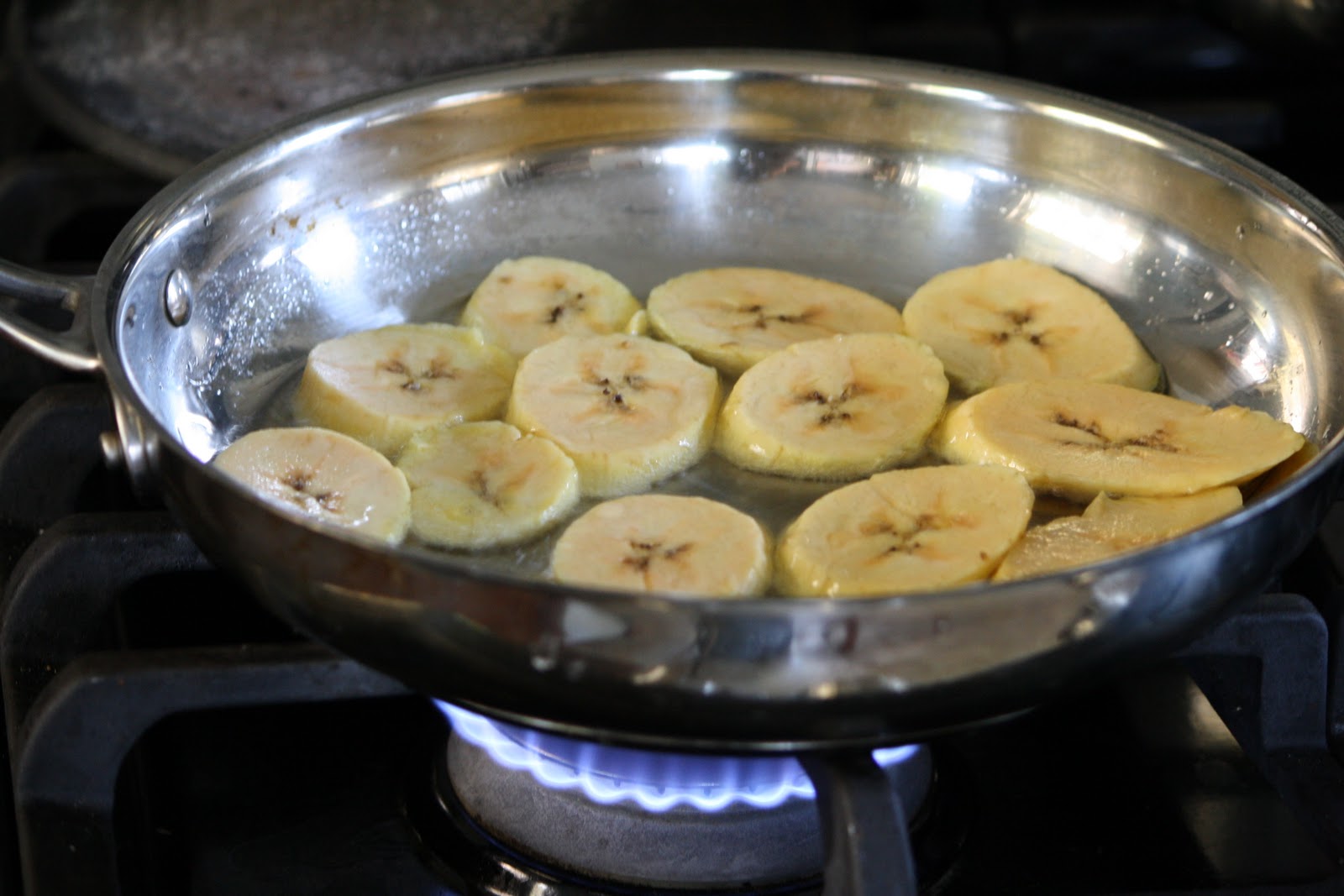
Fry plantain in canola or peanut oil

Saute chicken, onions and papaya, then add coconut milk


Papaya Chicken and Coconut Milk (Recipe adapted from foodbycountry.com)
Serves 4

8 boneless, skinless chicken breast halves, cut into 3/4-inch cubes ( used thighs)
1 papaya, peeled, seeded and thinly sliced
1-3/4 cup coconut milk (canned, bottled or fresh)
1 onion, chopped
Olive oil for frying

In a frying pan, heat the olive oil and cook chicken cubes over high heat until they are almost cooked (about 5 minutes).
Add the chopped onion and cook until the onion becomes clear, about 5 minutes.
Add the papaya slices and cook for 5 more minutes.
Remove mixture from heat and add the coconut milk.
Serve alongside mashed sweet potatoes and fried plantains.

Final Assessment:  This is a lovely, mild, slightly sweet dish, owing to the combination of papaya and coconut milk. I served the dish with mashed sweet potatoes and fried plantains. Very easy and very tasty!

© 2010-2011, What's Cooking in Your World? Sarah Commerford/All Rights Reserved

Wednesday, October 5, 2011

Day 164.5 Orange Sherbet with Amaretto


About a week ago I received an offer to sample and review a cookbook. Now, I'm over-the-top busy with work, not to mention that we have to temporarily move out of our house to have renovations done (thank you, New England winter, for the ice dams that sent water pouring into every bedroom). But when I saw the title of the cookbook, I couldn't pass up the opportunity: Ice Cream Happy Hour - 50 Boozy Treats You Spike, Freeze and Serve, by Valerie Lum and Jenise Addison. I mean really, what better way to relieve stress than to sit down with a beautiful bowl of boozy ice cream? Yes, please.

The brain children of this book are two New York City women who started experimenting with spiking ice cream  in their tiny Brooklyn kitchens. Valerie Lum, is the baker at Bierkraft in Park Slope, Brooklyn, where she specializes in baking brownies, blondies and cookies. Her partner in this wonderful endeavor is Jenise Addison, who grew up in Queens, graduated from the French Culinary Institute and now spends her time brining, curing, butchering and fermenting at Bierkraft. After months of experimenting with various formulations and spirits, the two hit on the ideal ice cream-to-booze ratio and perfected the chemistry. They figured out that they could fit as much as an entire cup of 80 proof alcohol into 1-quart of ice cream to achieve ideal consistency and flavor. That's some beautiful alchemy. Needless to say, this is decidedly grown-up ice cream and is not meant to be dished up to your eager toddler...or curious teenagers.

Ice Cream Happy Hour is organized by tantalizing categories: Boozy Ice Creams, 80-Proof Specialties, Cocktails in a Cone, Tropical Treats by the Scoop, Spiked Sorbets and Sherbets, Tipsy Sundaes and Floats. Following a lively introduction, the book gives simple, easy step-by-step directions (including photographs) on how to make and spike, temper, thicken and chill the custard; dissolve the gelatin (the thickening agent that counteracts the alcohol's thinning properties) and churn the ice cream. Once you understand the process, the authors suggest you boldly go where no other has gone and experiment with your own combinations, of which there are so many, they couldn't all be included in their book.

I chose the Orange Sherbet with Amaretto recipe because I love sherbet as it's such a nice, creamy cross between ice cream and sorbet. Plus, I dig anything with amaretto in it. Lastly, this recipe is very easy, requiring no cooking.  I must admit to taste-testing this sherbet more than once as it was churning. It's reminiscent of an orange cream-cycle with a just right dose of almondy amaretto - absolutely bowl-licking delicious!  Once the construction crews are out of my house, I fully intend to try the following more complex recipes from Ice Cream Happy Hour: Caramel with Spiced Rum, Fig with Barley Wine, Ginger with Dark Rum, White Russian and Cosmopolitan. The boozy possibilities as positively endless!

Lemon juice, orange juice and sugar form the syrup

Whisk it all together until completely blended

Add milk - now you've got yourself a cream-cycle!

Dissolve gelatine

Icy cold amaretto...mmm

Whisk in gelatine and amaretto, then immediately pour into ice cream maker and churn


Orange Sherbet with Amaretto (Recipe reprinted with permission from Ice Cream Happy Hour, authors and Ulysses Press)
Makes 1 quart

1 cup sugar
2 cups fresh orange juice
1 Tbsp. fresh lemon juice.
1-1/2 cups milk
1 tsp. vanilla extract or almond extract
1 packet (1 Tbsp.) gelatin
1/3 cup cold water
3/4 cup cold (refrigerated) amaretto

Make the syrup: In a medium bowl, whisk the sugar, orange juice, and lemon juice together until the sugar is completely dissolved.
Whisk in the milk and vanilla or almond extract.
Cover and chill the syrup for at least 4 hours.
Once the syrup is completely cold...
Dissolve the gelatin: Pour water into a small saucepan and evenly sprinkle the gelatin on top.
Allow to sit until the gelatin appears to have absorbed as much water as it can, about 2 minutes. This is called blooming.
Gently warm over low heat and stir until the gelatin is completely dissolved in the liquid, about 3 minutes.
Spike the syrup with the cold amaretto and gelatin mixture: Refrigerate the alcohol until completely cold (do not try to speed up the process by putting it in the freezer, which may make the gelatin set up too much before added to the syrup.
Pour the gelatin into a medium bowl and whisk the cold alcohol until combined. Do not attempt to kip this step by pouring the alcohol directly into the saucepan with the gelatin.
Pour the cold orange syrup into a large bowl. Stream the alcohol and gelatin mixture through a fine mesh strainer into the syrup and whisk until thoroughly blended.
Churn the sherbet: Pour the cold mixture immediately into the ice cream maker and churn for at least 20 minutes. Due to the alcohol content, you may wish to churn it longer to get the desired thickness. If you don't want to serve the sherbet immediately, or you want a firmer texture, transfer it to a freezer-proof container and freeze for several hours before serving.


© 2010-2011, What's Cooking in Your World? Sarah Commerford/All Rights Reserved

Wednesday, September 28, 2011

Day 164! Slovakia - Mushroom Soup (Hubová Polievka) - Up Next, Solomon Islands


This recipe comes courtesy of a great Slovakian website, slovakcooking.com, that I discovered while searching for a meal to represent Slovakia. If you're into Central European cooking, this is a terrific resource that includes traditional food, photographs and descriptions that make the recipes easy to follow, not to mention lively writing and anecdotes from the author, Luboš Brieda. Luboš lived in Slovakia until moving to the U.S. when he was 14. Missing his country and it's traditional cooking, he started a blog dedicated to the dishes he enjoyed growing up. Although it was difficult to choose from the many recipes he has posted, I chose mushroom soup, or hubová polievka - because ever since my friend Ben took me mushroom foraging last week, I've been on kind of a shroom bender (and I mean that in the most legal way). This dish is easy, traditional and perfect for a cool fall night. I used fresh crimini mushrooms because I spotted them in the store and they looked gorgeous, but you can use dried or standard white button mushrooms if that's what's available. And, of course, this soup has bacon in it, and any one who knows me, knows I'm a bonafide bacon fiend. Thank you, Luboš!

The Slovak republic is a land locked country in Central Europe that is bordered by the Czech Republic, Austria, Poland, Ukraine and Hungary. Slavs first arrived in what is now present day Slovakia in the 5th and 6th Century during the migration period. Throughout history, regions of Slovakia belonged to various empires, such as Samo's Empire, which is the first known political unit of Slavs, as well as the Austro-Hungarian Empire and Czechoslovakia (with a few others in between). During WWII, a separate Slovak state briefly existed, and between 1939-1944, Slovakia was a dependency of Nazi Germany. From 1945-1991, the country was ruled by Czeckoslovakia, but by 1993, Slovakia declared itself an independent state. A beautiful country known for it's mountains, skiing, scenic lakes, valleys and rivers, Slovakia is also the world's largest producer of cars, claiming production factories for Volkswagen, Bratislava, PSA Peugeot Citroen and Kia.

Slovakia's somewhat temperate climate is warm in the summer and cold in the winter. Although there is no such thing as "Slovakian" food, the cuisine varies from region to region and is influenced by traditional customs and peasant cooking. Food tends to be simple, yet hardy and very easy to prepare, often using just one pot. Heavy on meat, especially pork,  potatoes, dumplings, thick sauces, cheese also dominate the culture. Cabbage, beans, corn, lentils, dense, chewy bread and seasonal fruits are all enjoyed in Slovakian homes and restaurants.

Crimini Mushrooms - But you can use dried or white just as easily

Potatoes give the soup texture and thicken up the stock

Mmmmmm....Bacon - no more need be said 

Sour Cream - I couldn't resist using this little Carnival Glass dish I picked up for a buck

Hubová Polievka - Mushroom Soup

Mushroom Soup -Hubová Polievka - (Recipe adapted from slovakcooking.com)

1 ounce dried, or 8 ounces fresh mushroom, sliced (I used fresh crimini)
5 cups water
3 large potatoes, peeled and cubed
4 sliced smoked bacon, chopped
2 Tbsp. flour
2 Tbsp. sour cream
Salt and Pepper to taste

Peel and cube potatoes and add to a large pot with salted water along with sliced mushrooms. Bring to a boil, then lower to a simmer.
Meanwhile, fry the bacon until crisp. When done, pour off most of the fat and add the flour, stir until combined, then add to the pot with the potatoes and mushrooms.
Simmer until potatoes and mushrooms are soft, then add sour cream and stir to combine.
Season and serve along with good hearty bread - I used pumpernickel rolls.


Final Assessment: Delicious! A simple, hearty soup, that goes well with thick slabs of bread and butter. I'll bet it would be even better tomorrow once the flavors had a chance to meld...but there isn't a drop left!

© 2010-2011, What's Cooking in Your World? Sarah Commerford/All Rights Reserved

Sunday, September 25, 2011

Day 163! Slovenia - Castagnaccio (Chestnut Cake) Up Next, Slovakia


Lately I've been into savory cakes;  the kind my kids generally turn their noses up at, which is all the better for me, because I actually get to have more than one slice before it vaporizes. There are many, many wonderful recipes from the country of Slovenia, but when I came across this one for Castagnaccio (Chestnut) Cake, I knew I wanted to make it as I'd never cooked with chestnut flour before and the country has a long history of cooking with chestnuts, especially during times of war when foraging for nuts and berries meant the difference between sustenance and famine. Plus, the thought of olive oil, rosemary, golden raisins and pine nuts combined in a cake sounded so intriguing that I couldn't help but bi-pass all the other great recipes I found in favor of this one. I ordered the flour from Amazon, but you may be able to find it at Whole Foods or an Italian specialty shop.

I believe it's best to live life with no regrets - no matter the impulsive decision (which I make daily -- habitually), and this is one of those split second choices I can confidently say I'll never regret. But...my husband did not share in my enthusiasm - nope, he did not like the cake at all. This is an extremely dense, almost pudding-moist cake, with a creamy texture to which he took an immediate dislike.  Despite only having 8 tablespoons of sugar, it's also very rich, but not sugary thanks to the natural sweetness of the chestnut flour and raisins, so a small slice is all that's needed. And, while I thought the addition of rosemary scented and flavored the cake to sublime heights, he didn't didn't agree in the least. After the second bite, and a somewhat queasy smile, he politely pushed the plate away. I, on the other hand, loved that the earthy chestnut flavor was completely foreign to my palate. Should you try this cake, do try to let go of your preconceived cake-as-I know-it notions and enjoy this rustic, savory confection. I can imagine Castagnaccio with a sweet dessert wine or a cup of good strong espresso.

Located in the heart of Europe where the the Alps meet the Mediterranean and the Pannonian Plains meet the Karst, Slovenia is bordered by Austria, Hungary, Croatia and Italy. Among one of the most biologically diverse countries in the world, Slovenia is home to over 24,000 animal species. This beautiful country is the 3rd. most forested country in Europe and boasts some of the most pristine lakes, streams and thermal springs. Historically, Slovenia was part of many different states such as the Roman Empire, Holy Roman Empire and the Hapsburg Monarchy. During World War II, the country was occupied by Germany, Italy, Hungary and Croatia, eventually emerging as a Yugoslavian state. Finally in 1991, the country attained full sovereignty. A deeply devout and secular nation, Slovenia has over 3,000 churches and chapels.

Owing to Slovenia's rich history and proximity to other countries, its cuisine is quite diverse and is regionally influenced (hence this cake that's also made in Tuscany) by neighboring borders. In general, animal fat, cream, butter and eggs form the basis for much of its cooking. Stews, porridge, pork, poultry, potatoes, beans, cabbage, mushrooms, wild greens (regrat) are all enjoyed. Chestnuts, walnuts and hazelnuts are frequently used in desserts along with strawberries, loganberries, blackberries, blueberries and honey.

Pine nuts, olive oil, sultana (golden) raisins and rosemary flavor the cake

Soak the raisins in warm water for a few minutes to plump them up

Chestnut flour has an earthy and unique flavor

Only 8 tablespoons of sugar sweeten this cake

A few strokes of the whisk gets all the lumps out of the batter without over mixing

Top batter with rosemary sprigs and drizzle olive oil

The cake is done when little cracks appear on top

Castagnaccio (Chestnut Cake) - (Recipe adapted from Epicurious.com)
(Recipe can be divided in half and baked in a 9" pan to make a thinner cake)

1 lb. chestnut flour
8 Tbsp. sugar
Pinch of salt
6 Tbsp. sultana (golden) raisins
6 Tbsp. pine nuts
A few sprigs of fresh rosemary
5-1/2 Tbsp. extra virgin olive oil, plus extra fro drizzling
4 cups cold water

Soak  raisins for a few minutes in warm water.
Mix the chestnut flour, oil, salt, sugar and water - using a whisk helps break up any lumps.
Drain the raisins and mix into the batter, along with pine nuts.
Pour the batter in a greased 10"- spring form pan.
Sprinkle rosemary sprigs over the top of batter and drizzle with a little olive oil.
Bake at 400 F for 45 minutes
Cake is ready when the surface is covered with little cracks.
Cool and serve.


© 2010-2011, What's Cooking in Your World? Sarah Commerford/All Rights Reserved

Sunday, September 18, 2011

Day 162.5 - Buttery Pear Pine Nut Cake


This simple, rich cake has been the go-to cake in my family for as long as I can remember. It's one of those cakes that can be put together at the last minute, topped with whatever fruit you happen to have on hand with 100% guaranteed awesome results - no matter your baking ability.  It's so easy to assemble, that once you've made it a few times, you'll have the recipe memorized, which is when the experimentation and fun really begins. My mother makes it using little prune plums (which I believe is the original recipe), and I have made it with everything from peaches, to pineapple to today's choice, pears. When I use pears, I like to top them with a little cinnamon, a sprinkling of sugar and pine nuts. Happy Sunday!

Start with firm, ripe pears

Six ingredients  - easy, right?! (not shown, pinch of salt and vanilla)

Cream butter and sugar with a wooden spoon - no need for a mixer

Add eggs and mix well

 Core and slice pears, then fan them out on top of the batter


Squeeze half a fresh lemon on the fruit to keep it from discoloring (gives it flavor too)

Sprinkle with sugar and top with pine nuts

Now skip dinner and go eat cake

Buttery Pear Pine Nut Cake


1 cup flour
1 cup sugar
1 stick sweet unsalted butter, softened
1 tsp. baking powder
Pinch of salt
2 eggs
1 tsp. vanilla
Italian prune plums, pears, peaches, apples or pineapples...or any fruit you like!
Fresh lemon juice
Pine nuts (optional)

Preheat oven to 350 F.
In a bowl, cream butter and sugar until fluffy. Add eggs and vanilla and mix well.
Add flour, baking powder and salt to butter mixture, and blend until creamy.
Spoon into 9-inch greased cake pan (batter will be very thick)
Smooth the top and arrange fruit on top.
Squeeze 1/2 fresh lemon on fruit (to keep it from discoloring)
Sprinkle with cinnamon and sugar.
Top with pine nuts (optional, if using pears)
Bake for 45-50 minutes (depending on how juice fruit is), or until a toothpick inserted in the center comes out clean.

Serve warm or at room temperature.

© 2010-2011, What's Cooking in Your World? Sarah Commerford/All Rights Reserved

Friday, September 16, 2011

Day 162! Singapore - Singapore Noodles - Up Next, Slovakia


It's a beautiful, cool New England night -- even the air smells like fall. The sun is notably lower in the sky now, which means I have to cook a little earlier (and faster) to photograph in natural light. Luckily, this evening's meal of Singapore Noodles was both easy to prep and cook, so I got some shots off before the sun set. This was such a delicious and perfect dinner for the end of a long week, I wonder why I don't stir-fry more often? So now a little more about this beautiful and interesting country that's on my top 10 list of places I'd love to visit.

Located in South East Asia off the southern tip of the Malay peninsula, Singapore is an island country made up of 63 islands and separated from Malaysia by the Straits of Johor to its north and from Indonesia's Riau Islands by the Singapore Strait to the south. Singapore's earliest recorded history dates back to the 3rd century, but it was first settled in AD 1298-1299. During the 18th century, modern Singapore was founded. In 1819, Sir Thomas Stamford negotiated a deal to make Singapore a trading station, which attracted merchants from all over Asia, the Middle East and the U.S. When the Suez Canal opened in 1869, trade between the east and the west expanded even further, significantly increasing the population of Chinese, Indians and Malays. In 1941, Singapore was attacked and occupied by Japan during WWII, until Japan surrendered in 1945.  For a year, Singapore was a Crown Colony, but in 1959, it finally achieved with independence.

An extremely multicultural and diverse country, there are 4 major ethnic groups and accompanying languages: English, Chinese, Malay and Tamil. The language of the indigenous people is Bahasa Melayu or Malay. It follows then, that cuisine in Singapore is equally interesting, yet hard to categorize, with South and North Indian, Cantonese and Malay traditions and influences. Following is but a small sampling of some of the food, dishes and spices that make Singapore so interesting: Vegetarian thali, naan, bri yani, spring rolls, noodles, dim sum, roasted meat, soup, chicken,rice, steamed seafood, coconut milk, cardamom, cloves, cumin, coriander  chillies, ginger, turmeric, galangal root (I have some in my freezer!), lemon grass, curry leaves, shrimp paste, peanut sauce, bean curd and satay. There's not one thing in this list I wouldn't love to eat for breakfast, lunch or dinner.

Shrimp cut into small pieces and beef sliced super thin across the grain

Shittake mushrooms, sliced thin (I added extra)

Scallions and green beans, sliced on the diagonal

Curry - with crushed, dried red pepper added (I didn't have Madras curry)

Onions, sliced thin and crushed garlic

Rice Vermicelli noodles, soaked in boiling water for 5 minutes

Dry vermicelli noodles on a clean tea towel while heating the wok

 Stir-fry shrimp and beef first, then remove and set aside

Stir-fry mushrooms, onions and curry

Add vegetables, noodles and soy sauce - and that's it!


Singapore Noodles (Recipe Adapted from The Complete Stir-Fry, Edited by Helen Aitken)
(Serves 4-6)

150 grams (about 1/2 package) dried rice vermicelli
Oil for cooking
250 grams (8oz) beef, sliced super thin, across the grain
250 grams (8 oz) raw prawns, cut into small pieces
2 Tbsp. Madras curry powder (or regular curry powder with ground dried hot peppers added)
2 cloves garlic, crushed
100 grams (3-1/2 oz) shittake mushrooms, thinly, sliced
1 onion, thinly sliced
100 grams (3-1/2 oz) green beans, thinly sliced on the diagonal
1 Tbs. soy sauce
4 spring onions, thinly sliced on the diagonal

  1. Place the vermicelli in a large bowl, cover with boiling water and soak for 5 minutes. Drain well and spread out on a clean tea towel to dry.
  2. Heat the wok until very hot, add 1 tablespoon of the oil and swirl it around to coat the side.
  3. Stir fry the beef and the prawn pieces in batches over high heat. Remove from the wok and set aside.
  4. Reheat the wok, add 2 tbsp. of the oil and stir fry the curry powder and garlic for 1-2 minutes, or until fragrant. Add the mushrooms and onion and stir fry over medium heat for 2-3 minutes, or until the onion and mushrooms are soft.
  5. Return the beef and prawn to the work, add the beans and 2 tsp. water, and toss to combine. Add the drained noodles, soy sauce and spring onion. Toss well and serve.
Final Assessment: As I said before, I don't know why I don't stir-fry more often, especially when this meal was so easy and required very little prep. I didn't have Madras curry, so I used a mortar and pestle to grind some very hot dried red chillies, which I added into the curry. It gave the noodles just the right amount of heat. This might be the first time I used curry in a stir-fry, but it was excellent. I used shrimp and beef, but the recipe could easily omit meat or seafood altogether and add more vegetables. A great one pot  wok meal that my kids gobbled up with chopsticks.


© 2010-2011, What's Cooking in Your World? Sarah Commerford/All Rights Reserved