Wednesday, June 27, 2012

day 197! Zimbabwe - Sosaties (Grilled Marinated Meat with Apricots)


At last, twenty-six months after starting this world-wide cooking journey, I have reached my final country, Zimbabwe. I can't begin to express what an amazing trip this has been, and none of it would have been possible without the love, support and generosity of my family and friends. Looking back, I could never have imagined all the incredible food, experiences and friendships I've had the privilege to try and experience. Special props go to my Mom, who taught me everything I know about food and love. To my sister and brother who can cook it up and throw it down like the bosses they are. To my husband and children, who sampled, critiqued and went along with all my crazy rambling, endless peanut stews and still love me (you guys are saints). And to very special friends: Beth, Merri, Lucy, Lisa, Ben and John (who gave me tonight's recipe and wants everyone to know he's an Irish-Italian stud). Lastly, to all my new friends from around the world who gave me recipes, advice and shared your cultures with me with such openness and generosity - I am honored to be in your company.


A landlocked country in the southern part of Africa, Zimbabwe is bordered by South Africa, Bostwana, Nambia and Mozambique. At one time a British colony, Zimbabwe declared its independence in 1980. The main languages spoken in this African country are English, Shona and Ndebele. Although most of the country is a savana, it also has mountains, a tropical climate as well as evergreen and hardwood forests. Home to the world's biggest and most spectacular waterfall, the Victoria Falls attracts tourist from around the globe to witness its raw and beautiful power. Rich in biodiversity, Zimbabwe boasts 500 species of birds, 350 species of mammals such as rhinos, baboons and giraffes as well as a huge range of reptiles such as snakes and lizards. Zimbabwe has one of the largest platinum and diamond resources in the world, but these vast and valuable resources have not been fully realized due to poor governmental oversite, corruption and mismanagement. Fortunately, this is beginning to change, making the promise of the country's future more optimistic.

Food in Zimbabwe is based on mealie meal, a cornmeal and water porridge that is eaten alone or with gravy, vegetables such as spinach, greens, beans, sour milk, dried fish or peanut butter. Peanut and tomato based stews are also a common staples. Due to British colonization, rice, pasta, melon, sweet potatoes, pumpkin and potato-based dishes along with porridge and tea are still eaten by many. For weddings and graduations, goat or cow might be enjoyed. Closer to the South African border, Afrikaner recipes using jerky, sausage, beef lamb and pork might also be cooked for special occasions.

Chop up some onions, saute and add spices, vinegar and jam - simmer until thickened
Apricot jam, garlic, salt and curry (not pictured, tamarind paste)
If using dried apricots, reconstitute in sherry overnight - otherwise, use right from the box as is
Grill and serve!


Sosaties (Grilled Marinated Meat with Apricots) - Adapted from Global Gourmet

2 pounds lamb, cut into 1" pieces
1 pound pork, cut into 1/2" cubes
1 garlic clove, peeled
Salt, pepper
4 tablespoons oil
1 cup onions, chopped
1 tablespoon curry powder
1 clove garlic, minced
2 tablespoons sugar
1 tablespoon tamarind paste
2 cups white vinegar
2 tablespoons apricot jam
2 tablespoons cornstarch dissolved in
2 tablespoons red wine
1/2 pound dried apricots
1/2 cup dry sherry

Place the lamb and pork pieces in a large bowl that has been rubbed with the clove of garlic. Season with salt and pepper, and toss.

In a saucepan, heat the oil. Add the onions and sauté for 5-6 minutes, then add the curry powder and garlic. sauté for another minute. Add the sugar, tamarind paste, vinegar, and jam and stir well. Stir the cornstarch mixture and add it to the onions, and cook, stirring constantly, until it thickens. This should take about 3 minutes. Cool, then add to the meat and toss well. Marinate for 2-3 days.

One day before preparing the sosaties, combine the dried apricots and sherry in a small bowl, cover, and let sit overnight in the refrigerator.

Drain meat from sauce and reserve. Thread lamb, pork, and apricots on skewers. Grill over charcoal until browned on all sides. Serve with heated reserved sauce.

© 2010-2012, What's Cooking in Your World? Sarah Commerford/All Rights Reserved

Tuesday, June 19, 2012

Day 196! Zambia - Pineapple Chutney - Up Next, Zimbabwe


Today is the fist day in several weeks that I've had time enough to make a dish representing the second to last country in my world cooking journey. I decided to get up early to catch the morning light, as it lends such a beautiful patina to photographs. I'm pretty sure my neighbors think know I'm officially nuts. And, if you could have seen me hauling pineapple, peppers, lemons and oranges outside at 6 a.m., then tripping over my tripod on the way out the back door (in my pink dragonfly p.j.'s), you'd nod vigorously in agreement. I used to be quite sane but that was BT ( before teenagers). Don't be too judgy, though. If you woke up to Eminem's nasal tirade streaming out from under your kid's door every morning, you'd be loco too. But I digress.


A landlocked country in Southern Africa, Zambia is roughly the size of Texas or France and is known as one of the more peaceful, highly urbanized countries in Africa. Bordered by the Democratic Republic of the Congo, Tanzania, Malawi, Mozambique, Zimbabwe, Botswana, Namibia and Angola, Zambia is home to 72 ethnic groups. Originally, the country was inhabited by Khoisan people, but was colonized during the 13 century by the Bantu. European explorers discovered the country during the 18 century. In the 19 century, the country became a British colony of Northern Rhodesia, but by 1964, Zambia declared independence from the UK. In recent years, the country has undergone a strong period of economic reform, but the economic infrastructure of the country remains largely that of subsistence farming. Owing to vast natural resources and rich mineral and copper mining, the country has promising potential to someday compete in the global market.

Zimbabwe's climate is tropical to sub-tropical. Peanuts, cassava, chilli peppers, beans and corn are all grown here. The staple diet is corn-based in the form of Nshima. Maize or cassava flour are ground and mixed to a thick porridge that is eaten alone or alongside condiments with meats, fish, sour milk or beans. In fact, Nshima is such a huge and important part of the culture, that songs, poems, stories, rituals and folk lore have regularly referenced this dish that nourishes and sustains the country's people.


Pineapple Chutney
Cup up orange and lemon, leaving skin on
 Chop tomatoes, onions and peppers
 Chop fresh pineapple
 Sliver candied ginger
 Pot everything in pot, along with wine vinegar and simmer for about 30 minutes
 Cool and place in clean jar - I'm serving this with grilled chicken tonight :)


Pineapple Chutney (Recipe Adapted from Celtnet)

1-1/2 cups green bell peppers, cut into 1/2 sections
1 cup onions, chopped into 1cm pieces
1-1/2 cups fresh tomatoes, cut into 1/2-inch cubes
1 whole lemon, cut into 1/4-inch cubes with skin left on
1 whole orange, cut into 1/4-inch cubes, with skin left on
7/8 cup sultanas
2 cups fresh pineapple cut into 14-inch dice
1 cup white wine vinegar
3/4 cup white sugar
1/3 Muscovado sugar
4 tbsp preserved candied ginger, cut into thin strips
1 tbsp salt

Add all the ingredients to a large saucepan and simmer gently for 30 minutes (if the mixture seems too thick add up to 1 cup of pineapple juice). When ready allow to cool a little then pack into hot, sterile, jars.


© 2010-2012, What's Cooking in Your World? Sarah Commerford/All Rights Reserved

Friday, June 8, 2012

Day 195.5 China! Pot Stickers (Pan Fried Dumplings)


Only two countries left to go before I complete my world cooking journey, and I just can't bring myself to go there yet. So, in an effort to postpone the bitter-sweet inevitable, I'm circling way back to China  (the 36th meal I cooked when first starting out) to make my son Ian's very favorite Chinese appetizer - Pot Stickers.

The name alone should be reason enough to make these delicious pan fried dumplings, and the filling? Well, fugetaboutit. Traditionally eaten as a snack or an appetizer throughout China, these dumplings are actually very easy to make. Prepping the filling takes a little time, but after that, it's a piece of cake. Or a dumpling.  I forgot to get ground pork, but I had a small pork sirloin roast in the fridge, so I cut off a chunk and ran it through my food processor - presto. Note to self: grind your own pork and beef dummy; it's significantly cheaper than the pre-ground stuff, sans all the funky additives or filler mix-ins.

I made these this morning, so we had them for breakfast. Who cares if we all have garlic breath for the rest of the day - it's totally worth it. But, if you can't wrap your head around pot stickers for breakfast, they make a perfect appetizer, snack or side dish. And, if you want to make them vegetarian, simply dice up tofu in place of the pork. Enjoy!

 Dried Shitake mushrooms for the filling - how beautiful are these?
Soak for 30 minutes in warm water, then mince (I used my mini food processor)
 Mince two cups of napa cabbage
Filling: Chives, mushrooms, cabbage, soy sauce, sesame oil, ginger, garlic, ground pork and corn starch
Combine all ingredients and mix very well
 Brush the edges of a wonton wrapper with water (keep the others covered with a damp towel)
 Fill with one teaspoon of filling
 Fold, seal and pleat the edges
 Put on a cookie sheet that's been lightly dusted with flour - then fry, add broth and steam
  Sorry - I don't have a picture of them cooking because the only shot I had was blurry

Pot Stickers (Adapted from Williams-Sonoma, Asian)

1/4 cup dried shiitake mushrooms
2 cups finely chopped napa cabbage
1/2 tsp. salt
1/4 lb. ground pork
1/2 cup minced fresh garlic chives
1 Tbsp. each light soy sauce and Asian sesame oil
1-1/2 tsp. peeled and minced fresh ginger
1 clove garlic, minced
1-1/2 Tbsp. cornstarch
1/8 tsp. ground white pepper
45 thin, round wonton wrappers
4 Tbsp. canola or peanut oil
1 cup low-sodium chicken broth
Ginger-soy dipping sauce

Soak the dried mushrooms in warm water for 30 minutes, then drain, remove the stems and mince the caps.

In a large bowl, toss together the cabbage and salt and let stand for 30 minutes to leach out excess water from the cabbage. using your hand, wring out as much of the water from the cabbage as you can. Discard the water and place the cabbage in a clean bowl. Add the mushrooms, pork, garlic, chives, soy sauce, sesame oil, rice wine, ginger, garlic, cornstarch and white pepper. Using a rubber spatula, mix until very well and thoroughly combined.

To fill each pot sticker, place a wonton wrapper on a clean work surface and brush the edges with water - be sure to keep the other wrappers covered with a slightly damp kitchen towel to keep them from drying out. Place 1 teaspoon of filling in the center of the wrapper, fold the wrapper in half to enclose the filling, then pleat the out edge. Place finished pot sticker on a lightly floured baking sheet. Repeat until all the wrappers are full.

Preheat the over to 250F. In a large non-stick frying pan over medium-high heat, heat 1 tablespoon of the canola oil. Add 10-12 pot stickers, flat bottom down and in a single layer. Sear until gold brown on the bottom, 3-4 minutes. Next, pour 1/4 cup of the broth into the pan, cover and let steam until all the broth evaporates and the pot stickers are tender but still firm and the filling is cooked through, 4-5 minutes. Transfer to a platter, cover with aluminum foil and keep warm in the over.

Serve with ginger-soy dipping sauce.

Ginger-Soy Dipping Sauce

5 Tbsp. rice vinegar
1/4 cup light soy sauce
2 Tbsp. dark soy sauce
3 Tbsp. warm water
1-1/2 Tbsp. sugar
1 Tbsp. Asian sesame oil
1 tsp. Sriachi chili sauce
2 Tbsp. peeled, minced fresh ginger
2 tsp. minced garlic
2 tsp. red jalapeno chile or other fresh hot red chile, seeded and thinly sliced on the diagonal

In a small non-reactive bowl, whisk together the vinegar, light and dark soy sauces, warm water, sugar, sesame oil and chile sauce until the sugar dissolves. Stir in the ginger, garlic and chile. Use immediately or cover and refrigerate for up to 2 days. Also very good with noodles!

© 2010-2012, What's Cooking in Your World? Sarah Commerford/All Rights Reserved

Friday, June 1, 2012

Day 195! Yemen~Ghraybeh (Shortbread and Pistachio Cookies) with Homemade Rose Water - Up Next, Zambia


 Maybe it's because of my Irish heritage, or perhaps it's the neighborhood I live in that was settled by the Irish in the 1800's, but when the opportunity came along to make a homemade still, I simply couldn't resist. But don't get too excited. I'm not making hootch, rather, I'm distilling rose petals from my garden to make rose water. Aside from the thrill of making this heavenly scented concoction, most Middle Eastern and Arabic cooking uses some form of rose water, orange blossom or jasmine water in all kinds of cooking. Seeing as roses are in bloom, and I'm cooking in Yemen, I had to give this a shot. The end product is not as "rosy" as commercially sold rose water, but pretty close! As for the cookies, imagine rich, crumbly shortbread, scented with roses and spiced with exotic cardamom ~ lovely. Lastly, a big shout-out to my friend, Lee at Cambridge Cooks for the kitchen visit and Sofra snacks!

Map Courtesy of Lonely Planet
Located in western Asia, Yemen occupies the southwestern to southern end of the Arabian Peninsula and is bordered by Saudi Arabia, the Red Sea and Oman. Although Yemen is said to be one of the poorest countries in the Arab world, it is also home to some of the most beautiful architecture. The country's rich culture, once known as the "land of milk and honey", also claims the oldest city in the world in its capital city, San'a. Yemen is the only state in the Arabian Peninsula to have a completely republican government. Slightly over half of the country's population is Sunni, with the remainder being Shia.

Cuisine in Yemin is different from typical Middle Eastern cooking as it has Ottoman and Turkish influences, as well as Afghan, Moroccan, African and Arabian traditions. Chicken and lamb are the primary source of protein, with fish being eaten in the coastal region. Cheese, butter and dairy are eaten in moderation, but buttermilk, vegetable oil, ghee and clarified butter are used in cooking daily. Spices and seasonings often used include (but are not limited to)anise seed, fennel, ginger, honey, garlic, onions, chilies,rose and orange blossom water, sesame and poppy seeds. Tea and very strong coffee are enjoyed in restaurants and in homes.
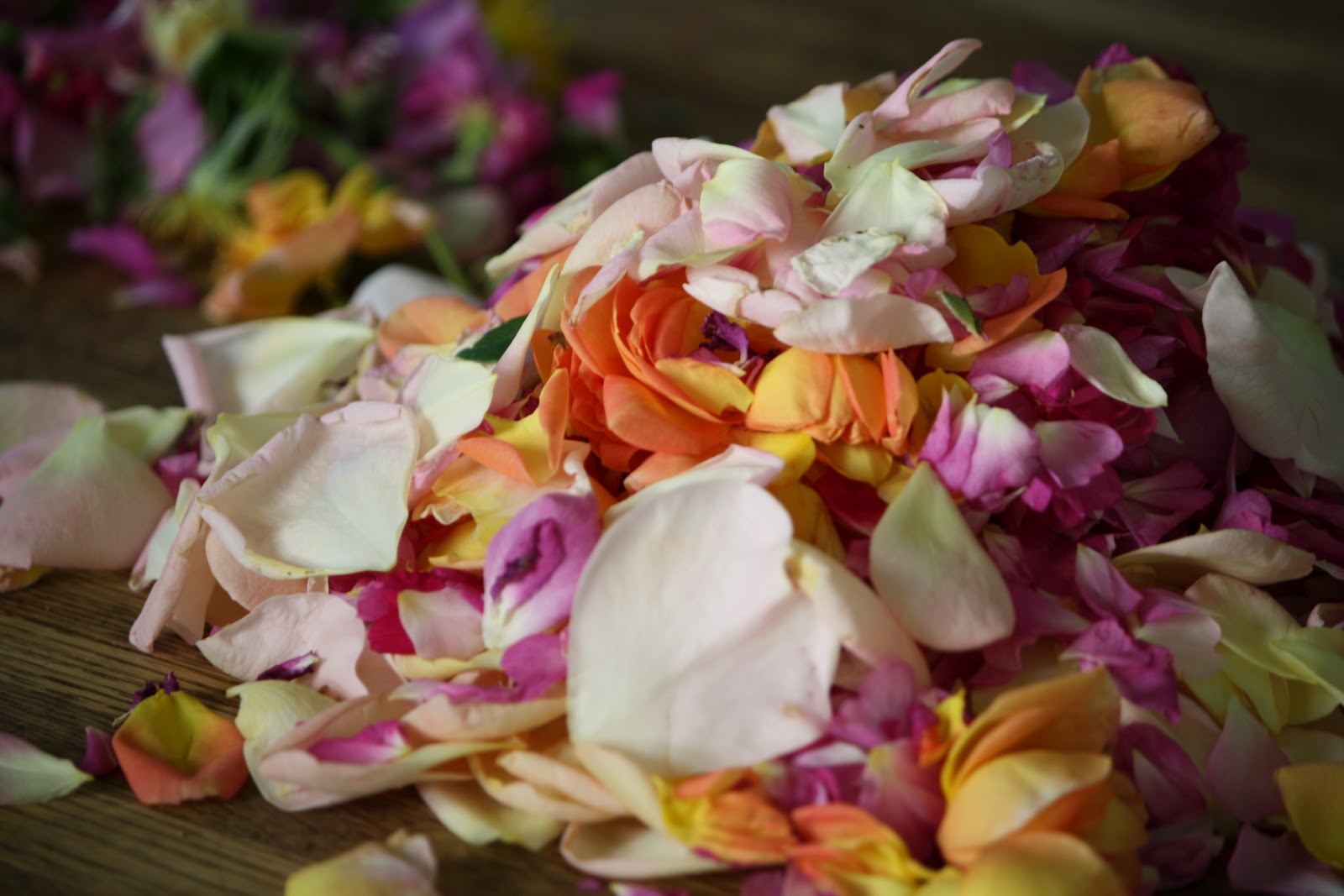
I picked a variety of roses from my backyard
Some are domestic and some wild tea roses
I took the petals off the stems

All you need to make a still: fire place brick, metal or glass bowl and a large pot with a domed lid

Once water comes to a boil, dump a bunch of ice on the lid. The ice melts and condensation drips down into the bowl.


For the cookies: semolina, powdered sugar, flour, canola oil and pistachios
...and cardamom and roses <3
Pine nuts and almonds can be used as well as pistachios
Shape the dough into an "s", diamonds or wreaths

The first batch did not hold its shape, so I added a little more flour (indicated in recipe below)

These delicate cookies are heavenly scented and flavored with rose water and cardamom

Ghraybeh (Shortbread Cookies) Adapted from The Spice House

1-1/4 cups all-purpose flour
1 cup semolina flour
1 cup powdered sugar, plus more for dusting
1 cup clarified butter (ghee), softened or canola oil
2 teaspoons rose water
1/4 teaspoon ground cardamom
1/4 cup (approximately) shelled pistachios
1/4 teaspoon fine-grained salt
Preparation Instructions
Preheat oven to 300 degrees.

Mix together the butter, sugar, and rose water until light and creamy. Sift together flours, salt and cardamom and stir into butter mixture until well combined. Chill dough for 30 minutes.

Form dough into grape-sized balls, then shape balls into wreaths, diamonds, "s" shapes, etc. (or leave round). Place a pistachio on each cookie.

Arrange cookies 1 inch apart on ungreased baking sheets. Bake 18-20 minutes, until cookies are dry to the touch and just starting to change color. Transfer cookies to a rack and immediately dust heavily with powdered sugar.

Makes about 3 dozen cookies.

Blanched almond or pine nuts can be used in place of pistachios. Rose Water can be substituted with orange flower water or with whiskey or other flavors.

Ingredients:

Homemade Rose Water - Adapted from care2com

Be sure you have a brick and heat-safe stainless steel or glass quart bowl ready before you begin.

2-3 quarts fresh roses or rose petals
Water
Ice cubes or crushed ice

1. In the center of a large pot (the speckled blue canning pots are ideal) with an inverted lid (a rounded lid), place a fireplace brick. On top of the brick place the bowl. Put the roses in the pot; add enough flowers to reach the top of the brick. Pour in just enough water to cover the roses. The water should be just above the top of the brick.

2. Place the lid upside down on the pot. Turn on the stove and bring the water to a rolling boil, then lower heat to a slow steady simmer. As soon as the water begins to boil, toss two or three trays of ice cubes (or a bag of ice) on top of the lid.

3. You’ve now created a home still! As the water boils the steam rises, hits the top of the cold lid, and condenses. As it condenses it flows to the center of the lid and drops into the bowl. Every 20 minutes, quickly lift the lid and take out a tablespoon or two of the rose water. It’s time to stop when you have between a pint and a quart of water that smells and tastes strongly like roses.


© 2010-2012, What's Cooking in Your World? Sarah Commerford/All Rights Reserved

Friday, May 25, 2012

Day 194! Vietnam ~ Vietnamese Summer Rolls with Nuoc Cham (Vegetarian) - Up Next Yemen


Tuyệt vời - That's as close as I can come to the Vietnamese translation for the word awesome. Vietnamese food is my very favorite Asian cooking style, as it relies on fresh, clean flavors and is much lighter than my close second favorite, Thai cooking. Plus the standard combination of mint, lemon grass and basil is just insanely, insanely sexy -- in an herby way. Without even thinking about it, I can tell you that  any time I'm lucky enough to get to a Vietnamese restaurant, I always order the Spring (Summer) rolls. I love the look and texture of the the rice paper wrappers, crunchy fresh vegetables, chewiness of the tofu, cellophane noodles and sweet/hot mix of the accompanying sauce. And of course, they're just so pretty. I've made won-tons, pot stickers and egg rolls before, but have never attempted these until today. All I can say is...dayyyam, these are slammin'. Working with rice paper took a little getting used to as it's super thin and very delicate, but after a couple of clumsy tries, I got it down. I hope you will too!

Map Courtesy of Lonely Planet
Vietnam is the eastern-most country on the Indochina Peninsula in Southeast Asia. Bordered by China, Laos, Cambodia and the South China Sea, this beautiful country boasts lush countrysides, mountains, a sparkling coastline and rolling rice fields. Having survived colonialism, communism and capitalism, Vietnam has finally come into its own and now considered one of the most spectacular countries on the earth to visit. The country became independent from China in 938, but was later colonized by the French in the mid 19 century. After the fist Indochina war, the French were expelled from the country, leaving Vietnam divided into south and north Vietnam. Following the Vietnam war in 1975, a communist government ruled the country until 1986 when market-based economic and political reforms took hold.

Cuisine in Vietnam is influenced by Chinese, French and Indian traditions. Dishes differ from region to region, but for the most part, fish sauce, shrimp paste soy sauce, rice fresh herbs, fruits and vegetables form the basis for this extraordinarily healthy food. Herbs such as lemon-grass, mint coriander and Thai basil leaves flavor and scent Vietnamese cooking. Unlike Chinese cooking that uses a fair amount of oil, Vietnamese cuisine uses far less oil and relies on fish, chicken, pork beef and seafood for protein. Known for beautiful, healthy vegetarian dishes (influenced by Budhist traditions and values), broths and soup-based dishes are also commonly eaten.


The basics: red leaf lettuce, cucumber, cilantro, mung beans, chilies and daikon
 Mint - the stuff that takes over my garden
 Julienned carrots and cucumbers
 Serrano chili for the Nuoc Cham sauce
 Rice paper wrappers (made in Vietnam)
 Working on a damp tea towel, lay the rice paper out, then put the lettuce leaf on first then layer the other ingredients - roll into a tight cylinder, tucking the ends in 1/2 way through.
 Slice on the diagonal and serve with sauce


Vietnamese Summer Rolls (Adapted from Williams-Sonoma, Asian Cookbook)

8 rice-paper rounds, (12-inches in diameter)
8 red-leaf lettuce leaves, stems removed
2 ounces cellophane noodles, soaked in warm water for 15 min. and drained
1 carrot, peeled and finely shredded
1/2 small cucumber, peeled and seeded, then finely shredded
1/2-lb. block extra firm tofu, cut into 16 slices, each 4-inches long by 1/4-inch thick
1/2 cup mung bean sprouts
Leaves from 1 bunch fresh mint
leaves from 1 bunch fresh cilantro

Working with 1 rice-paper round at a time, soak the round in warm water.

To assemble each roll, lay a lettuce leaf horizontally on the bottom half of the moistened rice paper. At the base of the lettuce place several strands of noodles, 1 teaspoon of the bean sprouts, and several leaves of mint and cilantro. Be careful not to over-stuff the rolls. Lift the bottom edge of the rice paper and carefully place over the noodles and other ingredients, then roll once to form a tight cylinder. Fold in the sides of the rice paper and continue to roll the rice paper and filling into a cylinder.

Place the prepared rolls, seam side down, on a platter and cover with a damp kitchen towel. The rolls can be held at room temperature for several hours before serving.

Just before serving, cut each roll in half at an angle. Serve with Nuoc Cham.

Nuoc Cham (condiment)


3 cloves garlic, chopped
1-1/2 tablespoons sugar
3 tablespoons fish sauce
2 tablespoons rice vinegar
2 tablespoons fresh lime juice
1 serrano chile, seeded and thinly sliced on the diagonal
1 tablespoon grated carrot
1 tablespoon grated daikon

Using a mortar and pestle (or mini food processor_), grind together the garlic and sugar until a paste forms. Transfer to a bowl and whisk in the fish sauce, rice vinegar, lime juice and 1/4 cup of water. Pour through a fine-mesh sieve into a clean bowl and add the chile, carrot, and daikon. Makes about 2/3 cup.

© 2010-2011, What's Cooking in Your World? Sarah Commerford/All Rights Reserved

Wednesday, May 16, 2012

Day 193! Venezuela - Alfajores: Dulce de Leche and Coconut Cookies - Up Next, Vietnam


Got myself a nasty little spring cold, but that's not enough to stop me from trying these amazing Alfajores cookies. I mean really - cognac, lemon zest, dulce de leche and coconut? A litle Hennesey will surely help with the congestion, and what sick girl doesn't feel better with a plate of cookies? I am a woman of appetite. Said to be traditional tea time or snack cookies, these have a wonderful, somewhat biscuit like texture that I love, and despite the ultra-rich dulce de leche filling, the cookies themselves are not over the top sweet. There are recipes for dulce de leche from scratch, but I used the quick version in which sweetened condensed milk is simply baked until golden brown. If you want a special cookie, with a unique South American flavor, I highly recommend you try these little gems of goodness.

Map Courtesy of Lonely Planet
Located on the northern coast of South America, Venezuela (Bolivian Republic of Venezuela), borders Columbia, Guyana and Brazil. This beautiful country's biodiversity includes habitats that range from the Andes Mountains, the Amazon Basin Rainforest, Llanos Plains and the sparkling Caribbean coast, to the Orinoco River delta in the east. Animal life includes manatees, Amazon River dolphins and crocodiles (to name but a few), as well as at least 1,417 bird species. Literally thousands of fungi and plant varieties grow wild in Venezuela, as well as at least 25,000 varieties of orchids. One the world's largest exporters of oil and oil reserves, Venezuela's economy has recovered from difficult years spent laboring under dictatorships, economic crisis and attempted coups to become a significant player in the global economy.

Cuisine in Venezuela varies greatly by region, but is influenced by indigenous and European influences, as well as by African and Native American traditions. Corn, rice, plantains, beans, potatoes, tomatoes, onions, eggplant, squash, beef and chicken are all staple foods enjoyed in this country.

Cream butter, sugar, then add egg yolks and egg
 Lemon zest gives the dough a wonderful, citrus flavor 
 Corn starch and all-purpose flour make a light cake flour
 Can anything with Hennessy by bad? That's a rhetorical question
Kneed the dough, then let rest for 15 minutes
 Cut into 2" rounds
 Spread dulce de leche on one cookie, then top and roll sides in coconut
 At my husband's suggestion, I drizzled a little dulce de leche on a few cookies
 Presto - these lasted about 10 minutes in my house before the dudes devoured them


Alfajores (Recipe Adapted from About.com)

12 tablespoons sweet unsalted butter
1 cup granulated sugar
1 egg
2 egg yolks
2 tablespoons cognac
2 1/2 cups cornstarch
1 cup all-purpose flour
1 teaspoon vanilla extract
1/2 teaspoon baking powder
Zest of 1/2 lemon
Dulce de Leche
Grated coconut

Cream the butter and sugar together, then mix in the remaining ingredients except the dulce de leche and coconut until well blended. Knead on a floured work surface until the dough is smooth and let rest for 15 minutes.

Roll the dough out to a thickness of about 1/4 inch and cut into 2-inch rounds. Place on a greased cookie sheet and bake in a preheated 300°F oven for 20 minutes. When cool, spread some dulce de leche on the bottom of half the cookies and press another cookie on top, allowing some of the dulce de leche to squeeze from the sides. Roll the sides in the coconut until the sides are covered.

To make dulce de leche:

Pour 1 can sweetened condensed milk into 9-inch pie plate. Cover with aluminum foil. Place the pie plate in a in larger shallow pan filled with hot water. Do not allow the water to cover the smaller pan. Bake at 425 degrees F for 1 hour or until thick and caramel-colored.


© 2010-2012, What's Cooking in Your World? Sarah Commerford/All Rights Reserved